(513) 810-5367

Water Heater Guide

Water Heater Repair vs. Replacement: How to Decide

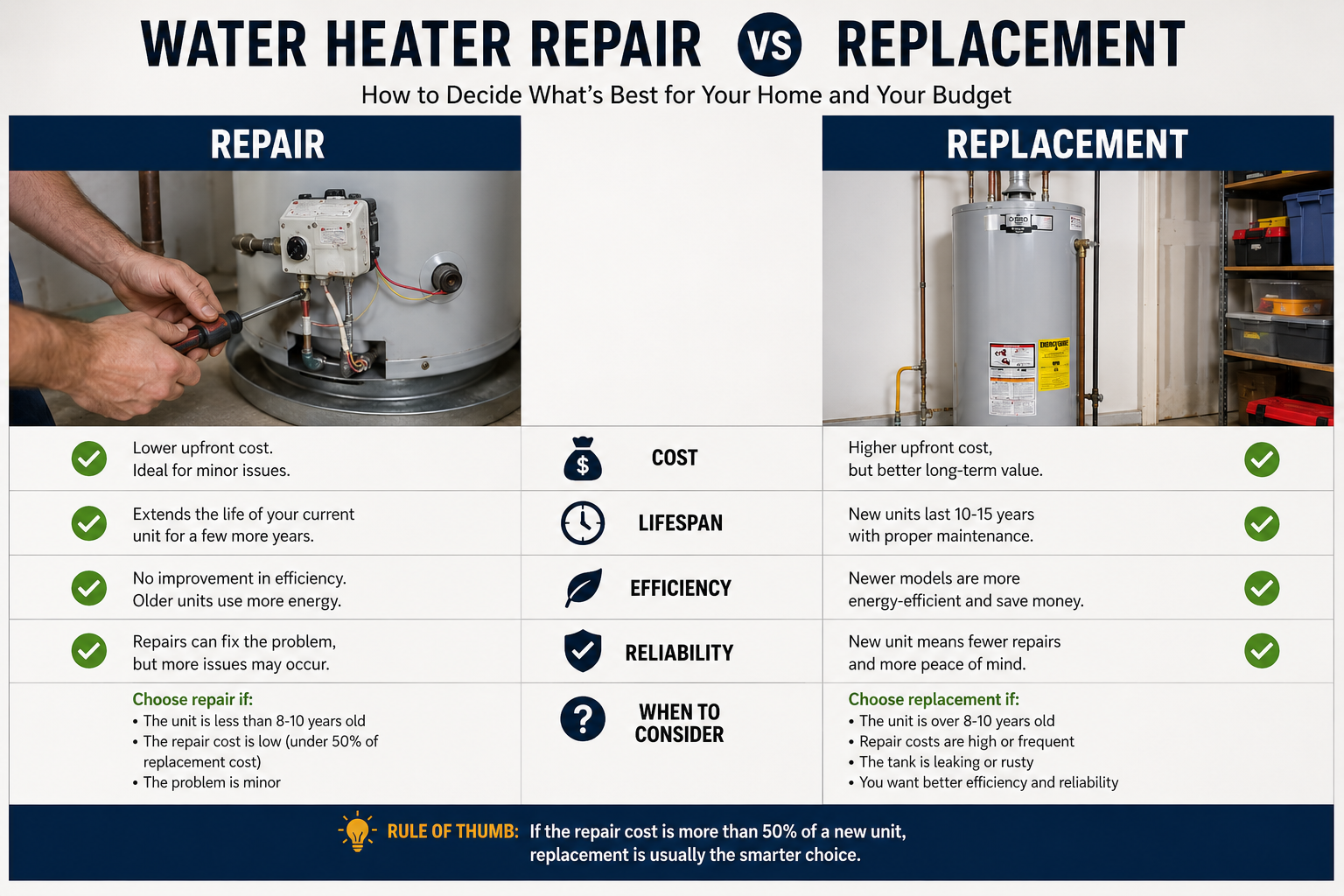
A failing water heater always raises the same question: fix it, or replace it? The honest answer depends on the unit's age, what's actually broken, and its repair history — not a fixed rule. Here's how to think through the decision before you spend money on either option.

  • Honest Repair-or-Replace Advice
  • Written Pricing Before Any Work
  • Serving Cincinnati & Northern Kentucky
Professional Service
Same-Day Service
Gas • Electric • Tankless
Residential & Commercial
Emergency Service
Upfront Pricing

The Decision Framework

Three factors that actually matter

Weigh these together rather than looking at any one in isolation.

1. Age relative to expected lifespan

A standard tank water heater is generally built to last 8 to 12 years. Tankless units tend to run longer, often 15 to 20 years, since they don't hold standing water that corrodes the tank from the inside. A unit still well within its expected range is usually worth repairing when something goes wrong. A unit at or past the far end of that range is entering the window where the metal, seals, and internal components are simply more likely to fail again soon, repair or not.

2. What specifically failed

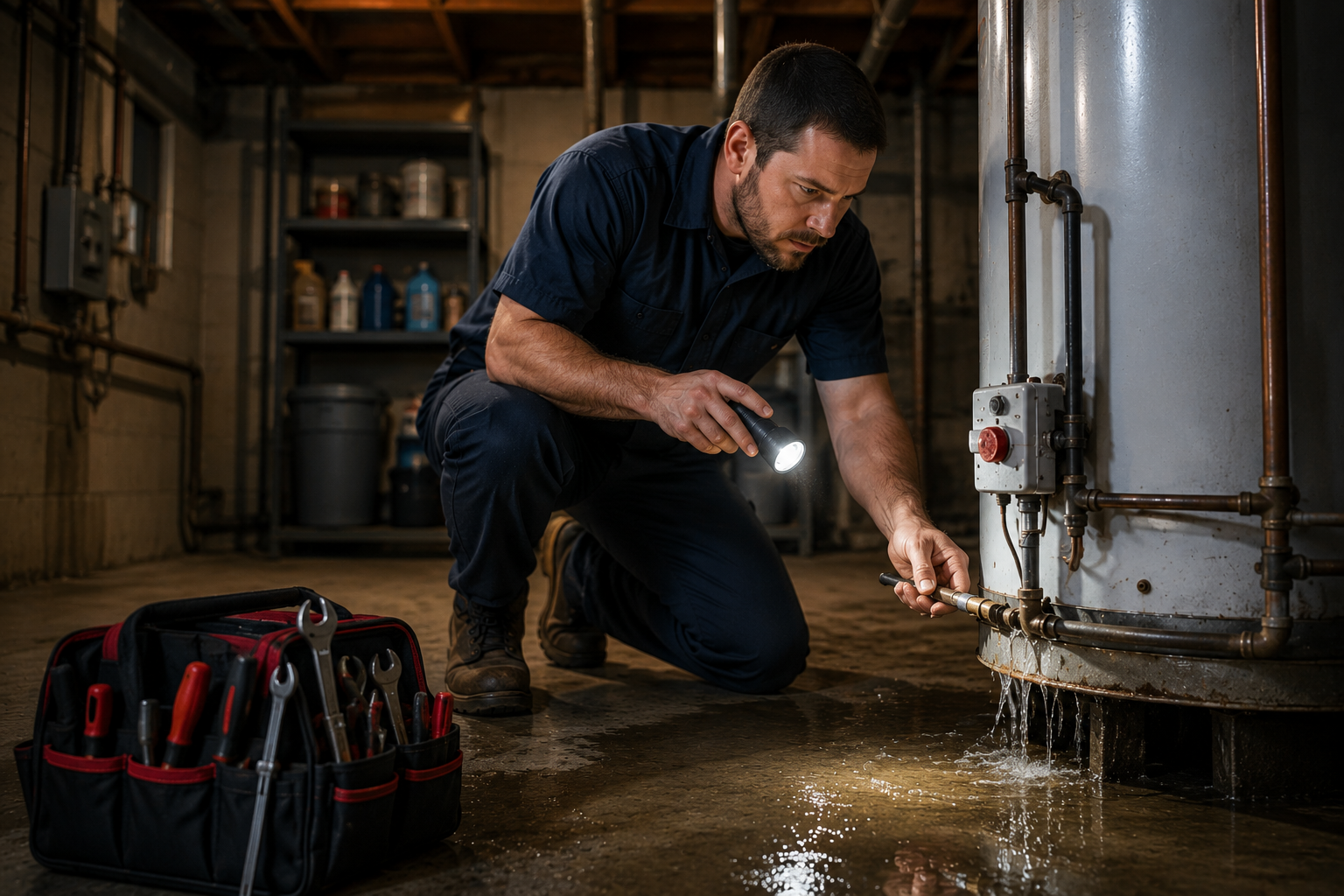
Not every failure is equal. A thermocouple, heating element, thermostat, gas valve, or igniter are all individual components that can be replaced without touching the tank itself, and repairing them doesn't say anything bad about the tank's overall condition. A leak from the tank body, visible rust perforation, or a cracked inner tank is a different category entirely — these mean the tank itself has failed, and there is no repair that fixes a corroded steel tank. That distinction alone resolves a lot of repair-or-replace decisions on its own.

3. Repair history and pattern

A first-time repair on a unit with no prior issues is a very different situation than a second or third repair within a year or two. Repeated failures, even of different components, often mean the unit as a whole is simply wearing out, and continuing to repair it piece by piece can end up costing close to what a replacement would have, without actually solving the underlying problem.

Reading the Signs

What usually points which way

Neither list is a guarantee on its own, but together they tend to make the decision fairly clear.

01

Signs repair is the better call

The unit is under 8 years old, this is the first significant issue, the failed part is a component rather than the tank itself, and the repair cost is a small fraction of what a new unit installed would cost.

02

Signs replacement is the better call

The tank itself is leaking or visibly corroding, the unit is past 10 years old and facing a repair, this is the second major issue in a short window, or the household has clearly outgrown the unit's capacity.

03

A gray area worth a second look

A unit in the 8 to 10 year range with a moderate repair cost. Here, the repair-versus-replace math is close enough that it's worth asking a technician for both numbers side by side before deciding.

04

When efficiency tips the scale

Even when a repair is affordable, an aging unit is often less efficient than a current model. On a unit already near the end of its life, that ongoing cost difference can make replacement the better long-term value.

Cost Considerations

How to compare the costs fairly

The sticker price of a repair versus a replacement is only part of the picture.

Weigh the repair against the unit's remaining life, not just the bill

A $200 repair sounds identical whether the unit is 2 years old or 11 years old, but the value is completely different. On a newer unit, that repair buys years of remaining service. On an older one, it may only buy a year or two before another component fails. Ask yourself not just "can I afford this repair" but "how much more life does this repair actually buy me."

Add up repair costs across a short window

A single repair rarely makes replacement the better financial choice on its own. Two or three repairs within a year or two, though, can add up to a meaningful fraction of a new unit's installed cost, at which point you've paid a lot without actually resolving the underlying reliability problem.

Factor in what replacement gets you beyond just "new"

A replacement is also a chance to correct a unit that was undersized for the household to begin with, or to convert to a tankless system if that fits your situation better. Those upgrades have their own cost, but they solve problems a repair never could, since a repair can only restore a unit to its original design, not improve on it.

What Homeowners Should Do

A practical way to work through the decision

Five steps to a decision you can feel confident about.

  1. 1

    Confirm the actual cause

    Don't guess based on symptoms alone. A technician testing the actual component gives you a real answer instead of a guess, and it's the only way to know if you're dealing with a fixable part or the tank itself.

  2. 2

    Check the unit's age and history

    Look at the manufacture date, usually on a sticker on the unit itself, and think back on whether this is the first issue or one of several in recent memory.

  3. 3

    Get both numbers, not just one

    Ask for the repair cost and a comparable replacement cost side by side. A straightforward technician will give you both without pushing you toward the more expensive option.

  4. 4

    Weigh the numbers against the three factors

    Age relative to lifespan, what specifically failed, and repair history. If two or more point toward replacement, that's usually your answer.

  5. 5

    Decide, and move forward with a written price

    Whichever direction you choose, get the cost confirmed in writing before any work begins, so there's no ambiguity about what you're paying for.

Frequently Asked Questions

Common questions about repair vs. replacement

A standard tank water heater typically lasts 8 to 12 years, depending on water quality, maintenance, and usage. Tankless units tend to last longer, often 15 to 20 years, in part because they don't hold standing water that accelerates internal corrosion the way a tank does.

It depends on what's actually wrong. A unit past 10 years with a genuinely minor issue, like a thermostat, can still be worth a small repair. But once a tank is in that age range, the odds of a second failure within a year or two go up, so many homeowners choose to replace rather than keep repairing an aging tank piece by piece.

Most individual repairs, like a thermocouple, heating element, or thermostat, cost meaningfully less than a full replacement. The comparison changes once a unit needs a second or third repair within a short period, since those costs add up and start to close the gap with what a new unit would cost installed.

A leak coming from the tank itself, rather than a fitting or valve, means replacement rather than repair, since a corroded tank can't be sealed. A unit past 10 years old facing a second major repair, or one that's clearly undersized for the household, are also strong signals that replacement is the more practical choice.

If the leak is coming from a fitting, the drain valve, or the pressure-relief valve, yes, those are repairable. If the leak is coming from the tank itself, meaning the steel has corroded through, there is no repair for that. The tank has to be replaced.

It depends on the household. Tankless units cost more upfront to install, but they take up less space, can supply continuous hot water, and typically last longer than a tank. They tend to pay off best for households that regularly run out of hot water or want to free up utility space, while a simple tank swap is often the more budget-friendly choice for a straightforward replacement.

A single, well-diagnosed repair can absolutely extend a unit's working life by a few years. What repair generally can't do is reverse the effects of internal tank corrosion once it's begun, which is why the same repair sometimes doesn't hold and a similar issue resurfaces on an aging unit.

Look at the repair cost against the unit's age and repair history, not just the dollar amount in isolation. A $200 repair on a 3-year-old unit is an easy call. A $200 repair on a 11-year-old unit that already had a repair last year is worth weighing against the cost of a new unit, since you may be paying twice in a short window.

It can, especially on older units. Water heaters built more than a decade ago are generally less efficient than current models, so on an aging unit, replacement can bring a lower monthly operating cost on top of resolving the immediate problem, which is worth factoring in even if the repair itself is affordable.

Ask what specifically failed, whether that same part or a related one is likely to fail again soon, and how the unit's current age compares to its expected lifespan. A straightforward technician will walk you through the repair cost and a comparable replacement cost side by side rather than pushing one option.

Get a Free Estimate

Not sure which way to go? Let's take a look.

No obligation, no pressure. If it's an active leak, a gas smell, or you have no hot water right now, skip the form and call — our emergency repair service gets you seen faster.

  • We give you both the repair and replacement cost, in writing
  • Estimates are free and come with no commitment
  • Serving Cincinnati and Northern Kentucky
(513) 810-5367

By submitting, you agree to be contacted about your request. We don't sell your information.